

Mining Payload Management:
A Practical Guide to Implementation
In almost every mining operation we visit, payload management is a primary topic of discussion. The challenges are universal: determining the ideal target payload for various truck fleets, configuring systems correctly, establishing reporting standards, and managing abusive overloading.
Because it impacts everything from mine planning and production to component longevity, payload management involves stakeholders across operations, engineering, and maintenance. These discussions can often become contentious, as each department has its own perspective on how to record and manage data (and conflicting priorities such as “get more tonnes” and “extend chassis life”).
However, the benefits of optimisation are undeniable. Safely maximising hauled tonnage while minimising operating costs (maintenance, fuel, and tyre wear) directly impacts the bottom line.
In a collaborative effort with a major gold mining company, we implemented a standardised payload management optimisation initiative across nine of their sites. The company projected that boosting the average payload by a mere one tonne would lead to significant benefits:
Over 2.5 million additional tonnes per year, OR
Nearly $2M in OPEX savings due to fewer required cycles for the same tonnage.
Having helped numerous sites navigate these complexities and reach a consensus, we have compiled our key recommendations for implementing a robust payload management framework.
Background
Payload can potentially be measured at various points in the mining process. This could include onboard truck payload systems (e.g. Caterpillar VIMS & TPMS and Komatsu PLM), loading tool systems (e.g. MineWare, ShovelMetrics), weigh scales (E.g. Transcale, Avery, Walz), derived payloads from survey, volumetric scanners, belt systems, etc. This can be recorded into their own systems and databases, as well as interfaced with a variety of ‘middleware’ solutions such as Fleet Management Systems (Wencomine, Modular Dispatch, Hexagon/Jigsaw, Caterpillar MineStar, etc.). This creates a confusing number of ways to measure and record payloads, often leading to disagreements on what the correct numbers are in reports.
Reach out to the MTS team at info@minetechservices.com to discuss how we can help you navigate this complex topic.
1. What Should the Target Payload Be?
Agreeing on what to measure is a critical step when targeting payload optimisation. The calculation for the fleet can be done in a variety of ways, and it’s important to balance accuracy with practicality. More on this below.
Wet/Dry, Bank/Loose, Tons/Tonnes, Nominal/Actual…
Agreement on what the material will be used for reporting is crucial, as it can have a significant impact on the numbers and avoid confusion in group discussions.
During the planning process, there may be assumptions made on material densities, moisture content, etc. and units of measure defined. When executing the plan, this should be aligned with what is being produced, as the loading tool operator, truck payload system, weigh scales, etc., will visually see (on screens, truck scoreboards, etc.) the loose, wet tonnage values.
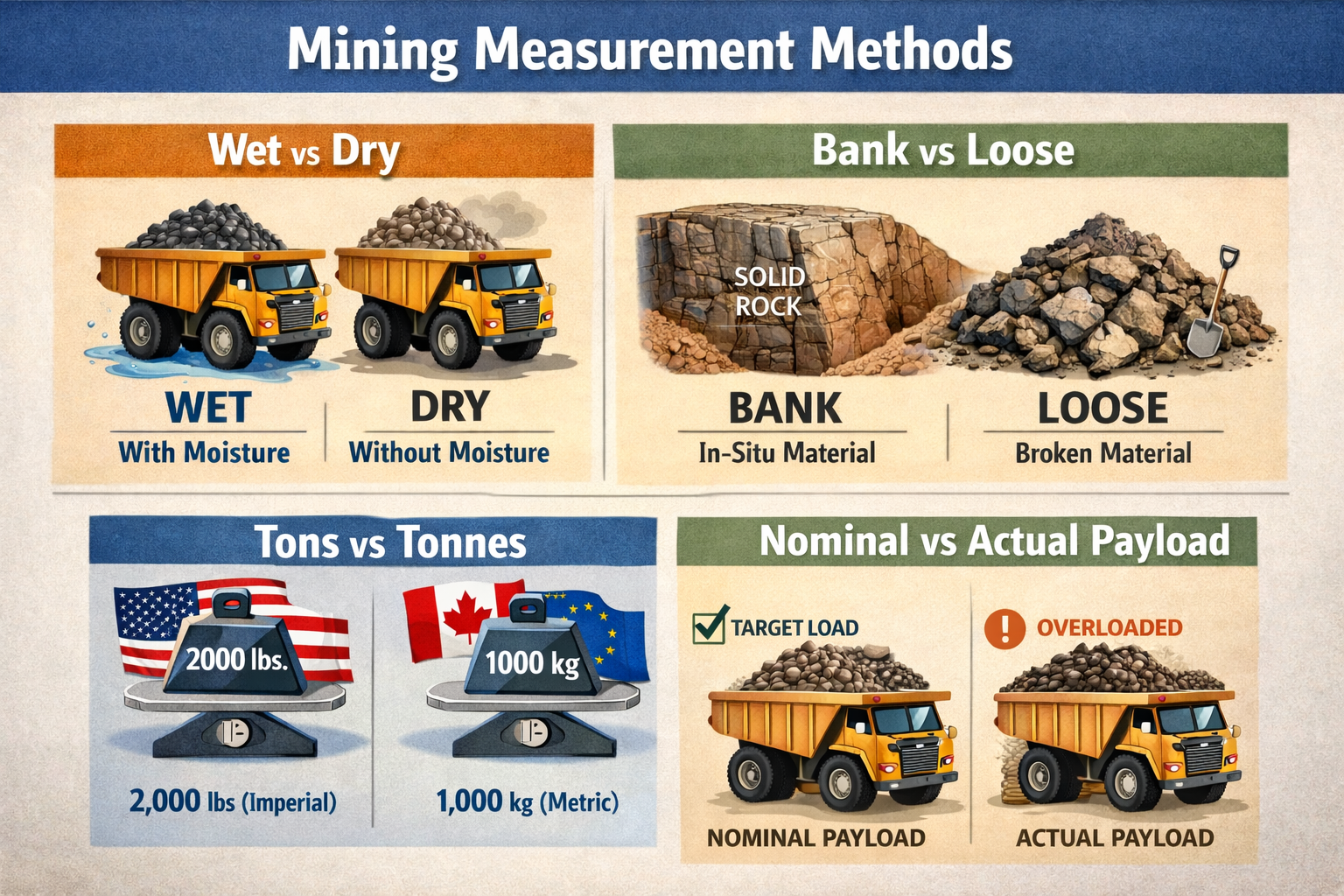
Wet Vs Dry - Trucks will haul ‘wet’ material at whatever moisture content exists at the time.
Bank Vs Loose - Trucks will be loaded with broken/blasted material (loose).
Nominal Vs Actual - It is always better to use actual (where possible). Using nominal may be ‘easier’ as you simply count trucks, but it hides true production (and the opportunity for payload optimisation), as well as damaging overloads. Getting “actual payload” working whilst it does require some additional truck maintenance pays dividends - and typically a well-maintained site will have the trucks scales within +/- 5% during a scale study.
Imperial Vs Metric - This should be aligned with the reporting system used by the site/the company group.
For reporting, the tonnage can be converted between each other if required, though it would be recommended to minimise the number used to avoid confusion and mistakes.
Recommendation:
Payload target reporting should be on Wet Loose Actual Tonnage.
Target Payload Calculation from GMOW
Each machine will have a Gross Machine Operating Weight (GMOW) specified by the OEM, which represents the total mass of the mining truck when loaded to 100% of the target payload. This includes all items such as the machine itself, fuel and fluids, wear packages/liners, fire suppression systems, payload, etc.
To calculate the target payload, the empty operating mass must be determined. This should ideally be the empty truck when it is at its peak empty operating mass, i.e. fully fueled, new tyres, liners, etc. If partially filled/worn sites should compensate for this in the calculation.
Target Payload = GMOW - Empty Machine Mass
For example, according to the Caterpillar 793D Specalog, the GMOW is 383,848 kg (846,240 lb) with a standard empty mass of 152,684 kg (336,611 lb)
In this case, Target Payload = 383,848 kg - 152,684 kg = 231,164 kg (509,629 lb)
It’s important to note that the empty mass varies greatly on site, as the configuration of each truck typically differs from a ‘standard’ version, even from the factory. During the life of the fleet, trucks also typically ‘evolve’ with additions of varied bodies, additional ladders, fire suppression systems, wear packages, greedy boards, etc..
Some operations attempt to increase average payload by shifting the payload distribution curve to the right (e.g. targeting 105–110% of OEM payload). While this can deliver mine productivity improvements, it is harder to manage and, in practice, typically results in:
Increased overload events.
Reduced component life (tyres, suspension, frame).
Potential OEM warranty risk.
Recommendations:
Use the OEM Gross Machine Operating Weight (GMOW) as a baseline to determine 100% target payloads.
To determine and validate what the empty machine mass is for each, at least annual weigh scale studies are recommended.
Scale Studies - brings validation and confidence
These are typically carried out periodically (if at all), with temporary scales being placed at sites from suppliers.
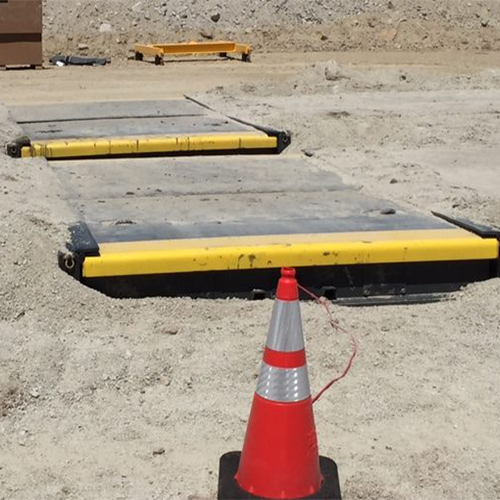
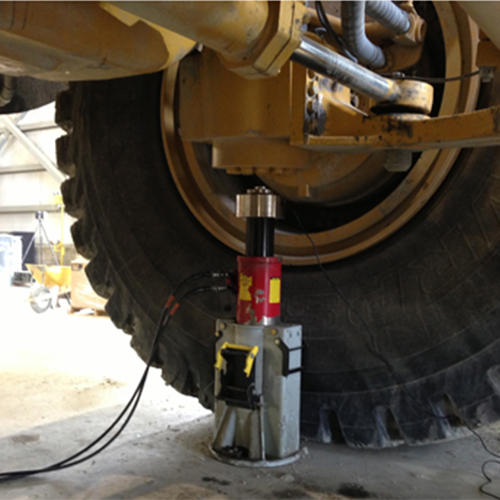
Portable Mining Scales and Jack Stand Scales (courtesy of Waltz)A robust scale study should:
Capture multiple readings per truck (loaded and empty).
Include different operating conditions (fuel levels, operators).
Be reconciled against the onboard payload system.
Identify systemic bias (e.g. consistent +5% over-read).
It is important that the outcome of the scale study is clarity on things such as the individual empty mass values for each truck (>70% of the fleet). Part of this should be the noting of influential (heavy) features such as different body types, wear packages, additional ladders, fuel level, etc. Why? This will allow for part-filled items to be compensated for, and to help determine ‘groups’ of trucks.
After applying any corrections for part-filled items, try to group the trucks under no more than 3 groups. This should be used practically in the field for loading tools to the target. Targeting more than 3 becomes very confusing and hard to manage, resulting in operations typically coming up with their own ‘rule’, e.g. 5 passes and kick out, or load until it spills over the sides, etc.
Recommendations:
Perform a scale study at least once every 12 months
Ensure the study includes impactful differences across the whole/majority of the truck fleet.
Try to define a middle ground/grouping of the trucks for practical use.
Communicate the results of the scale study to stakeholders - ensuring they see what is required for strut maintenance as well as positive outcomes.
Managing Different Truck Bodies
It is not uncommon for sites to trial different bodies on their truck fleets, including Caterpillar Mine Specific Design (MSD), DT High Load, Duratray. The aim is to typically balance cost, life and payload. This is typically done in batches and can lead to a fleet of trucks having different body types.
With different bodies typically comes significantly different empty mass for each truck, i.e. more than 5% of the empty machine mass. As per the payload study above, these should ideally be grouped for practical targeting. Operators will see the body differences and understand that its target should be X, Y or Z. As before, minimise the number of groups where possible; if two different bodies are about the same, use a single value for the target payload for both.
Ultimately, truck body ‘trials’ should be cycled out where possible over time to simplify the fleet.
Recommendation
Group different truck bodies with a single group target payload (where feasible) in your Fleet Management System (FMS).
Ensure reporting accurately reflects differing targets - this isn’t rocket science to do but often falls into the “too hard” bin when vendors are setting up the FMS.
2. Agreeing and Aligning Onboard Payload Systems
As mentioned, there can be a dizzying amount of possible places to capture payload, and it’s important to agree on what the source of the truth system is, and aligning dependent systems to avoid unexpected problems or confusion.
A common occurrence is for onboard payload systems to have incorrect payloads set and/or differ from the values seen on the in-cab screen. These can lead to confusion and targets being ignored, making optimisation much harder.
Which Payload Reporting System to Choose?
Most sites typically have truck onboard payload systems as their only source of actual payload (e.g. VIMS). This is commonly integrated into the mining Fleet Management System (FMS) and is reflected in the reporting, also appearing on the truck and loading tool screens for operators. Within the FMS, the target payload can be defined, and will be what is presented on the in-cab screen, i.e. the for loading tool operators to load to. As mentioned previously, trucks should be managed using common payload groups, to make it more practical to manage and load in the field.
Important note: It is possible for the FMS to default to a nominal payload should there be a problem with the onboard-to-FMS interface or onboard payload system. These should be quickly identified and resolved to ensure actual payload reporting is captured.
If set up correctly, some FMS, such as Wencomine, can integrate multiple payload inputs and have a payload priority ranking set for what will be used for reporting, if available, e.g. 1st Choice: Weighbridge → 2nd Choice: Loading Tool system → 3rd Choice: Truck Payload System.
With sites not using Wencomine, we have helped set up this payload priority reporting across the disparate systems, to great success.
With the FMS being the place where cycles, time usage, etc., are captured, it is the ideal location where payload should be used for productivity reporting.
Recommendations:
Use the FMS as the source of truth.
Resolve nominal reporting trucks as soon as possible.
Ensure the FMS payload targets are set as per the scale study and grouping.
Don’t Ignore the Onboard Configuration
As described earlier, most mining trucks have onboard systems to calculate payload, which can be reflected in loading lamps, scoreboards, etc. Even if another system is being used for payload reporting (e.g. volumetric scanners), these onboard systems will perform this calculation. It is important that these onboard systems are configured correctly with the target payload and overload limits, as per the scale study and grouping. This can be done using service tools (e.g. Caterpillar Electronic Technician (ET)) and is quick to perform; this can be campaigned over a couple of shifts during scheduled stoppages such as shift change, fueling, etc.
Tip: During this campaign, it is also a good opportunity to capture an overall onboard configuration snapshot (e.g. a Product Status Report, PSR) for checking other items at a later date.
Why is it important? Trucks typically have self-protect features and alarms associated with the payload. This would include things such as TKPH/TMPH alarms and overload alarms, which notify operators when they need to take corrective action. Some of these severe alarms (e.g. VIMS event code 2917 - Payload Abuse) will trigger ‘speed limiters’ when active. This typically restricts the truck to 2nd Gear or approximately 16 kph (10 mph).
Can these alarms and limits be turned off? In short, yes; however, we would strongly recommend they are left ON. Why? Muting these alarms simply hides potential overloads that could lead to damage and safety incidents. Should there be an investigation by MSHA, for example, would you want to defend turning off these alarms that could have prevented an incident?
It is better to configure correctly, calibrate periodically and manage true overloads.
Recommendations:
Configure the onboard truck system with the correct targets and limits.
Ensure alarms and limits are turned ON and configured correctly.
3. Managing Payload in Practice
With the way of measuring and the single point of truth (system) agreed upon, there is a practical need to manage and optimise payloads. Below are some of the areas we recommend being managed to ensure the greatest outcome.
Operator Training and Performance Management
A key differentiator with operational performance is the operator technique. It is critical that they are well-trained, aware of what is required of them, and are given the tools to measure/manage their performance.
With systems in place like the FMS and machine guidance (e.g. MineStar Terrain, ProVision), there is a vast amount of data that can be used to measure performance. The most important items should be identified and measured, with automated reporting, to accompany visual supervision of machine application by operators.
Supervisors should also be trained and armed with a quick reference “what good looks like” to help manage operators in the field. They will be able to drive real-time change when needed, and they are a key part of the change process.
If scorecards are used (which we have found to be greatly effective if implemented well), we would always advocate for a balanced ‘scorecard’ that contains a mix of production, safety, asset health and quality metrics for review.
Operational teams should collaborate with the training department, utilising its expertise. This partnership will involve the training department leveraging the reporting tools, established processes, and direct observations in the pit to develop targeted, individual learning plans for team members.
Policy and Process Supported by Data-Driven Reporting
Writing a concise payload policy for use by in-pit teams makes it very clear what is expected and how it will be managed. The inclusion of practical hints and tips, as well as handling of typical scenarios, such as what to do if an overload does occur, systems don’t function as expected, etc., should be included.
This should be communicated during the toolbox talks with each crew so that any questions or concerns can be addressed.
The definition, communication, and training on how to manage payload in practice greatly depend on the site. MTS has helped develop and deliver this for multiple sites, also providing support for front-line supervisors, in-cab training for loading tool operators, and supporting reports during the change.
Items to potentially communicate could include:
10/10/20 Rule
OEMs typically have this type of guidance for maximum life, and it is common for sites to use this as a baseline for targeting.
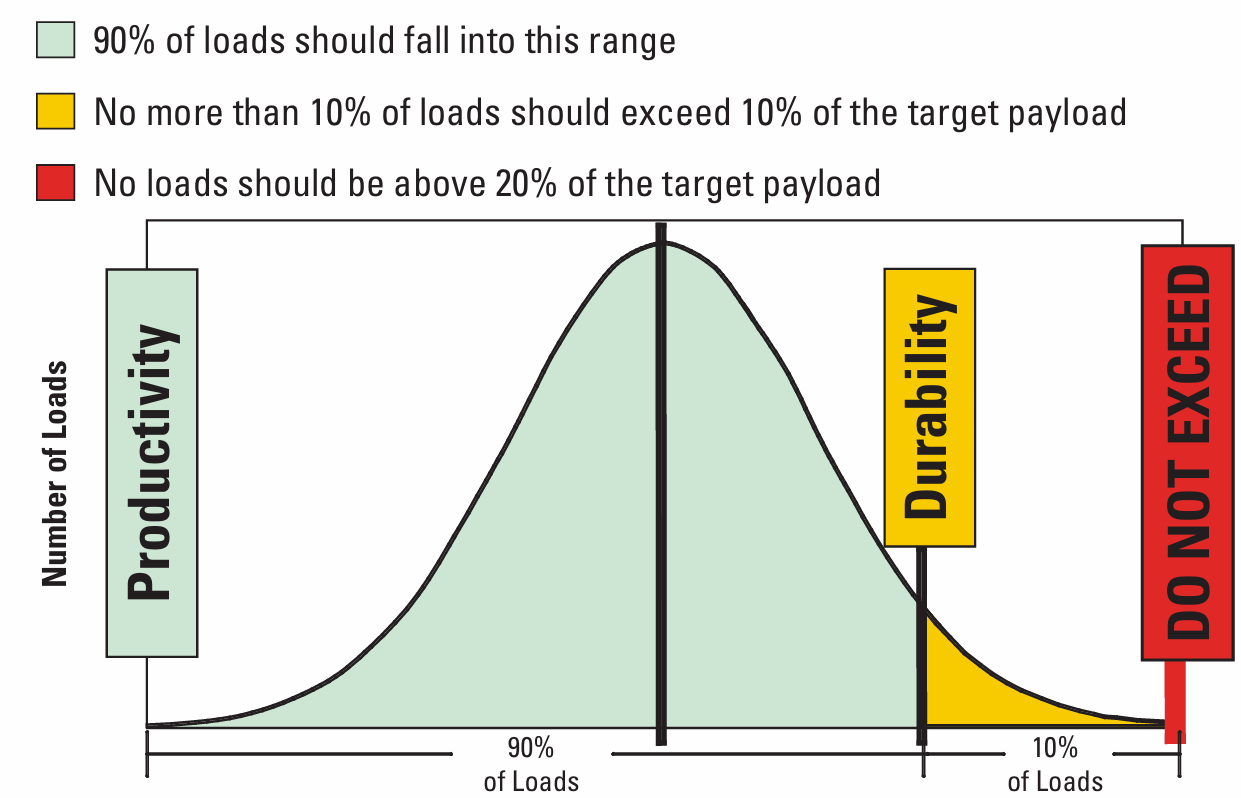
Managing OverloadsHaul truck overloading (particularly those over 120% of the target payload) can result in longer cycle times (especially if the speed limiter is triggered), equipment damage, tyre wear, higher fuel costs, and potentially exceeding safe brake limits, amongst other things.
What to do when an overload occurs? It is not unusual for the payload at the face to breach the 110% overload limit, only for it to settle down to a lower value at the 2nd gear reweigh. This type of overloading should be monitored but not actioned by operators, and the hauling should continue. If it remains overloaded, an action should be taken (as per the pre-defined policy by the site). This may include dumping and reloading, or hauling if not >120% to avoid dilution, etc., etc., depending on the site.
Who owns the overload alarm?
When determining where improvements can be made, it’s important to target the right ‘owner’ of the abusive behaviour. In the case of overload alarms, there should be a clear distinction made:
Overloads occurring at the face are the responsibility of the loading tool operator.
Overloads hauled (and not dumped back in the face) are the responsibility of the truck operator. They will have likely ignored alarms and messages and continued to haul.
Automated Compliance Reporting
Accompanying the payload policy, reports and dashboards should be created to help people easily monitor and manage. These vary depending on the site, but items we have created and found very effective have been included.
Payload distribution plotted against the ideal distribution curve.
Short interval control, in-shift performance by loading tool for pit supervisor field tablets.
Operator scorecards and performance management tools, including metrics such as:
Loading time
Bucket count
Payload accuracy
Payload position
Having automated reporting makes enforcing the policies, achieving gains and sustaining the change much easier, and it is recommended that this always forms part of a payload optimisation initiative.
Application Hints and Tips
For operators, there are some guidelines that can be shared and trained on to have the best chance of optimising payload. These could include items such as:
Centring the load using:
Good truck spotting technique (including spotting aids).
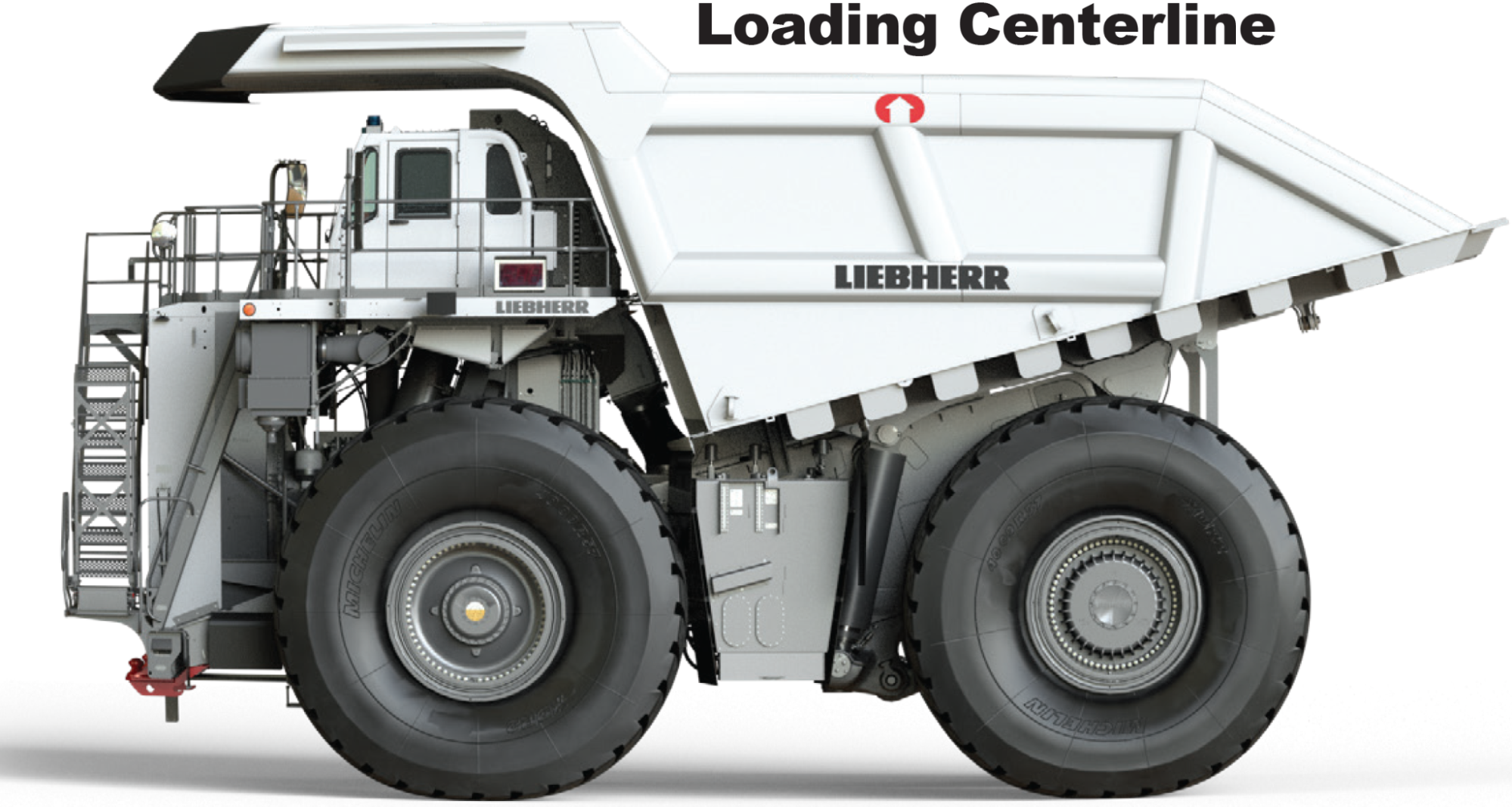
Addition of indicators/loading centerlines (typically placed above the lift cylinder upper pin).
Good loading technique, particularly when passes are 5+, i.e. place the first few passes forward/rearward of the centreline arrow, with the last 2 centred to achieve a good heap.
Bucket fill expectations & pass matching.
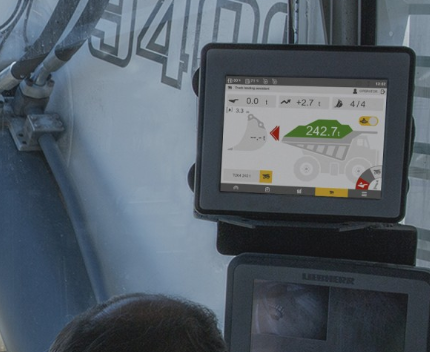
Use of onboard screens to guide loading.
Example Loading Tool Onboard Screen: Liebherr Truck Loading AssistanceFloor management to create a clean, flat loading area (as much as possible) to help ensure more accurate truck payloads.
Extra bucket Vs queue trade-off.
Overloads Vs Suspension Calibration
A fairly common occurrence at sites is the maintenance team advising the operations about overloads occurring, and operations pushing back that suspension cylinders aren’t calibrated properly.
We have found an effective way to centre these discussions is to have a single 1-pager report that contains the suspension condition, as well as cycle–level overloads (i.e. % based on final payload), as well as other items such as Rack, Pitch Bias. This allows a team to quickly determine the potential root cause and then take the appropriate action in their area of responsibility.
Further drill-down reports/tools should be created that cover:
Operations - Which operators are truly chronically overloading?
Maintenance - Which machines need attention, and possible suspension charging and calibration?
This type of reporting can normally be fully automated, which facilitates this brief discussion. MTS has delivered this and other tools to help break down silos and help these collaborative discussions at sites.
Payload System Calibrations
There are guidelines provided by OEMs about when truck payload calibration is recommended. Unfortunately, as it’s an as-needed job, it isn’t normally included in standard maintenance plans. To ensure it is taken care of when required, the following guide can be used (for Cat trucks).
SEHS9411 - Servicing the Suspension Cylinders for Large Off-Highway Trucks. This includes a section on “Conditions for Servicing”. Some of these indicators can be identified during equipment inspections, with others, such as the strut pressures and cylinder alarms, being able to be automated. An exception report could be created to highlight when cylinders are starting to drift out of specification, and service work can be scheduled. This is something that we would recommend be included on the operations-maintenance 1-pager on payload and system management.
Recommendation:
Create a suspension exception-based reporting on suspension calibration needs.
Payload Management Implementation: Summary
Effective mining payload management is not just about setting a target number — it is about aligning systems, people and governance to consistently achieve high productivity levels while maintaining safety and sustainability.
When sites:
Define a clear production basis
Validate true empty operating mass through scale studies
Group fleets for practical targeting
Align Fleet Management Systems as the source of truth
Configure onboard payload systems correctly
Implement operator scorecards and exception reporting
Establish shared Operations–Maintenance governance
…payload becomes a controllable performance lever rather than a source of conflict.
MTS specialises in helping sites deliver practical positive changes at site, using a data-driven approach for mining operations.
Contact us at info@minetechservices.com to discuss how we can help your site design and implement a structured payload management framework that delivers measurable results.