
Trend Exception Tool (TET)
See the future. Take action early. Prevent failures.
See the future. Act early.
Uses long term trend data and known operating limits to early identify issues before failures occur—often before any alarm codes are logged.
Analyses data over days or weeks
Uses known operating limits
Identifies risk before alarm codes are logged
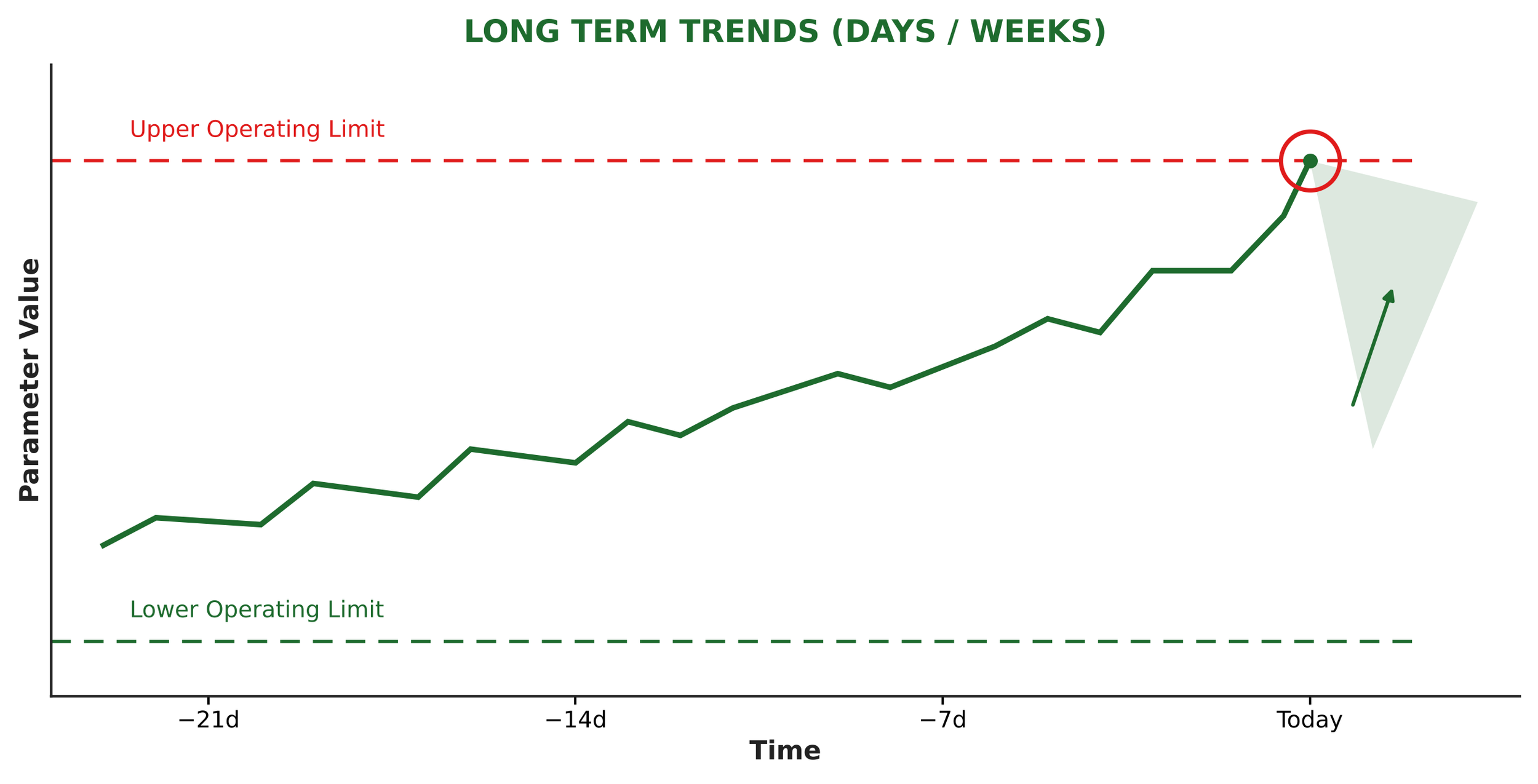
Most component failures don’t happen without warning. Long before an alarm sounds, the signs are already in the data: a temperature creeping up over weeks, a pressure that no longer responds the way it should, one truck drifting away from the rest of the fleet. On most sites, that drift goes unnoticed until the alarms start, and by then the damage can already be done.
TET turns your machine health data into long-term trends, and highlights the ones that are behaving outside expected norms. Asset health analysts and reliability engineers can spot deviations early, plan an intervention and avoid unscheduled failures.
TET works with data from manufacturers such as Caterpillar, Hitachi, Komatsu, Sandvik and Bridgestone iTrack and systems such as Cat MineStar, Modular Minecare and Wenco. The data is aggregated into hourly trends for long-term analysis. TET is a flexible platform and can be integrated into other systems that provide machine health data as needed.
Why It Matters?
Get ahead of failures. Find components that are deviating from expected performance or response while there is still time to plan the repair, order parts and schedule the downtime.
From reactive to proactive. A planned intervention costs a fraction of an unplanned failure, with its secondary damage, emergency parts and lost production. This proactive approach also allows for health conditions to be more easily managed, potentially extending the component life beyond what was originally budgeted.
See the whole fleet at once. Compare similar machines to tell whether an anomaly is specific to one asset or a fleet-wide issue that needs a wider response.
Exceptions First, So Your Team Sees What Needs Attention
Analysts don’t have time to scroll through hundreds of normal-looking trends. TET flags a channel as an exception when it moves outside expected behaviour such as:
Against configurable tolerances that reflect your site and conditions.
Against similar machines, comparing each asset with its peers/twins so that one unit drifting from the pack stands out.
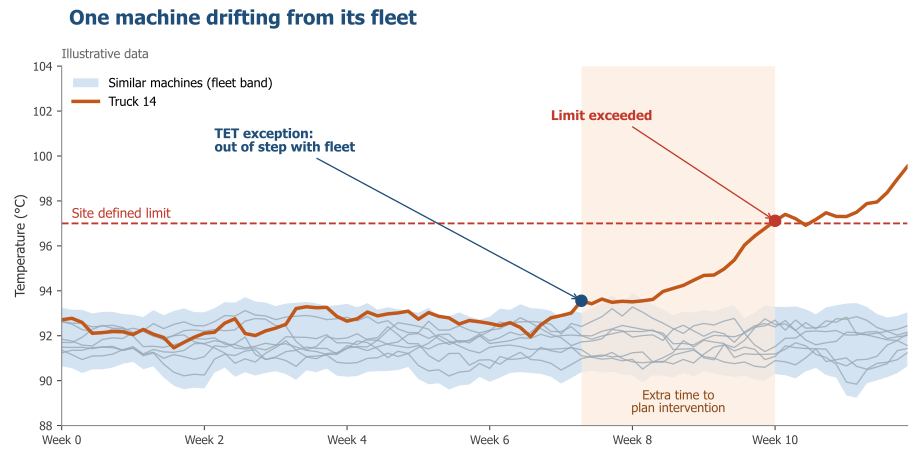
Exceptions are highlighted and shown by default within the application, and you can be notified when this occurs through email, chat message etc.. Healthy channels are still one click away, but they aren’t shown unless you load them, so your team starts each review with the trend exceptions that matter.
Virtual Trends: Monitor What The OEM Doesn’t
OEM trend channels only cover what the OEM chose to trend. MTS can create virtual trends from raw datalogger data, tracking the parameters and responses that matter to your operation, and aggregate them into long-term trends right alongside the standard OEM channels.
Virtual trends get the same exception highlighting as OEM channels, so gaps in OEM monitoring no longer become blind spots.
Combined Sources: One machine, one view
A single machine can report to several systems. The OEM monitors the engine, hydraulic system, etc., while a shovel payload system (like Mineware) monitors bucket payloads, and other systems track other parameters. Each system typically only sees its own channels, so the questions that span them go unanswered.
TET brings those sources together. Data from different OEMs and systems for the same machine is loaded in parallel and lined up on one timeline, so you can plot channels side by side that have never been seen together.
The combined view turns a symptom in one system into a cause you can act on and resolve.
Limits That Reflect Your Operation
Generic OEM thresholds don’t account for your haul profiles, climate or operating practices. TET tolerances are managed in the Asset Health Cookbook, where authorised users can tune them to site expectations, so exceptions flag genuine issues rather than noise.
TET and EDI: Both Ends of the P-F Curve
Failures develop along a P-F curve, from the point a problem first becomes detectable (P) to functional failure (F).
TET works on the left of the curve. It uses long-term health trends to detect deviations from expected norms early, giving you time to plan and intervene before damage escalates.
EDI works on the right of the curve. As alarms start to sound, and after failure, it gives you second-by-second data to understand exactly what happened.
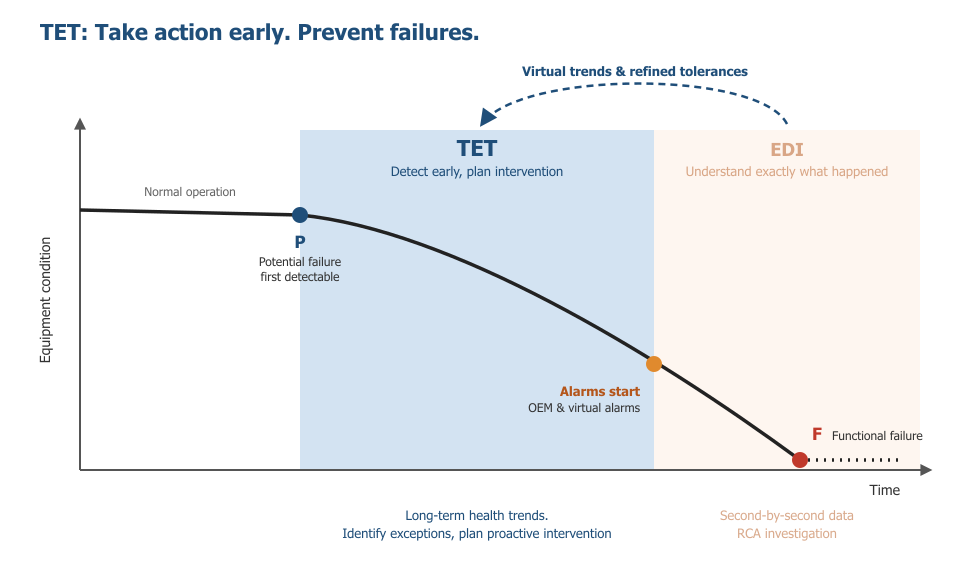
Together they close the loop: what Equipment Data Interface (EDI) reveals about a failure feeds new virtual trends and refined tolerances in TET, so you catch the warning signs earlier next time.
Features
Exception highlighting. Channels outside tolerance, or out of step with similar machines, are flagged and shown first.
Exception notifications. Get notified when a new exception is raised.
Fleet vs fleet comparison. Tell whether an anomaly is fleet-wide or asset-specific.
Virtual trends. Custom trends built from data-logger data, alongside OEM channels.
Multi-axis plotting. Plot multiple related trends together.
Health event overlay. See whether alarms are becoming more frequent as a trend worsens.
Configurable tolerances. Managed in the Asset Health Cookbook by authorised users.
SAP notifications. Create maintenance notifications in SAP directly from TET.
Zoom. Move from months of history down to individual hours.
Fully automated. No manual importing of data or files.
Browser-based. No desktop software to install.
Stop Reacting To Failures
TET has already helped sites identify fleet-wide health issues and avoid costly failures. If your team only finds out about failing components when the alarms start, talk to us. We’ll show you how TET helps you spot the warning signs early and act before failure.
Contact MTS To Get Ahead Of Failures
TET is installed and supported by Mine Tech Services’ dedicated service team.

Why Choose MTS for your Mining Technology Needs?
At MTS, we bridge the gap between mining technology, people, and IT. Our experienced team of mining technologists is dedicated to empowering mines to enhance productivity, minimise waste, and optimise costs through the seamless integration of technology.