
MTS Shortlisted for Two Mining Magazine Awards 2026

Mine Tech Services (MTS) has been shortlisted in two categories at the Mining Magazine Awards 2026: Underground Excellence and Software Excellence. Category winners will be announced in September 2026, but for our team, the real story isn't the trophy. It's what got us shortlisted in the first place: two site problems that had been sitting unsolved for years, fixed by combining existing technology and data in a smarter way.
Neither project began as a sales pitch. Both began with operations teams who were living with a productivity gap they couldn't quite see the shape of and who were generous enough to let us dig into their data alongside them.
Underground Excellence: Solving the Shift-Change Bottleneck Hiding in Plain Sight
A global tier-one mining company had invested heavily in teleremote-ready vehicles and automation, yet shift change remained a major, largely unquantified bottleneck underground. The technology was capable. The problem was visibility: data on machine automation, production, personnel movement, and delays was trapped across five separate, competing systems, Caterpillar MineStar, Epiroc/Meglab, Micromine Pitram, Newtrax, and VANTAGE — that had never been cross-analysed in a standardised way. Nobody could say with confidence why automated assets sat idle during crew changeovers, gas clearance windows, or face transit, because the answers were scattered across systems that didn't talk to each other.
Rather than recommending new hardware, MTS built true interoperability across the site's existing technology footprint, extracting and blending data across four pillars:
Teleremote logs — automation windows and system engagement
Production records — payload, cycles, idle time, and tonnes per hour
Personnel tracking — underground check-ins, cap lamp tracking, and face arrivals
Delay tracking — gas clearances, mechanical issues, and transit delays
The result was a minute-by-minute shift timeline mapping machine and human activity side by side, the first time the operation could see exactly when crews were heading to the portal, how long travel to the face was taking, and precisely when equipment sat idling during transition windows. The framework even isolated and quantified delays caused by blast-induced gas clearance, allowing automated fleet schedules to be realigned cleanly around mandatory ventilation procedures.
The measured impact:
+80% increase in production rate (tonnes per hour) during shift change;
+20% increase in equipment utilisation;
-15% reduction in time from shift start to first dump.
Software Excellence: Haul Road Explorer Finds What No One Else Could See
Haulage can account for 40–50% of a mine's operating cost, yet most sites still manage their road network reactively, repairing problems only once they become critical. The data needed to manage proactively usually exists; it's just siloed across fleet management, maintenance, and safety systems that were never built to talk to each other.
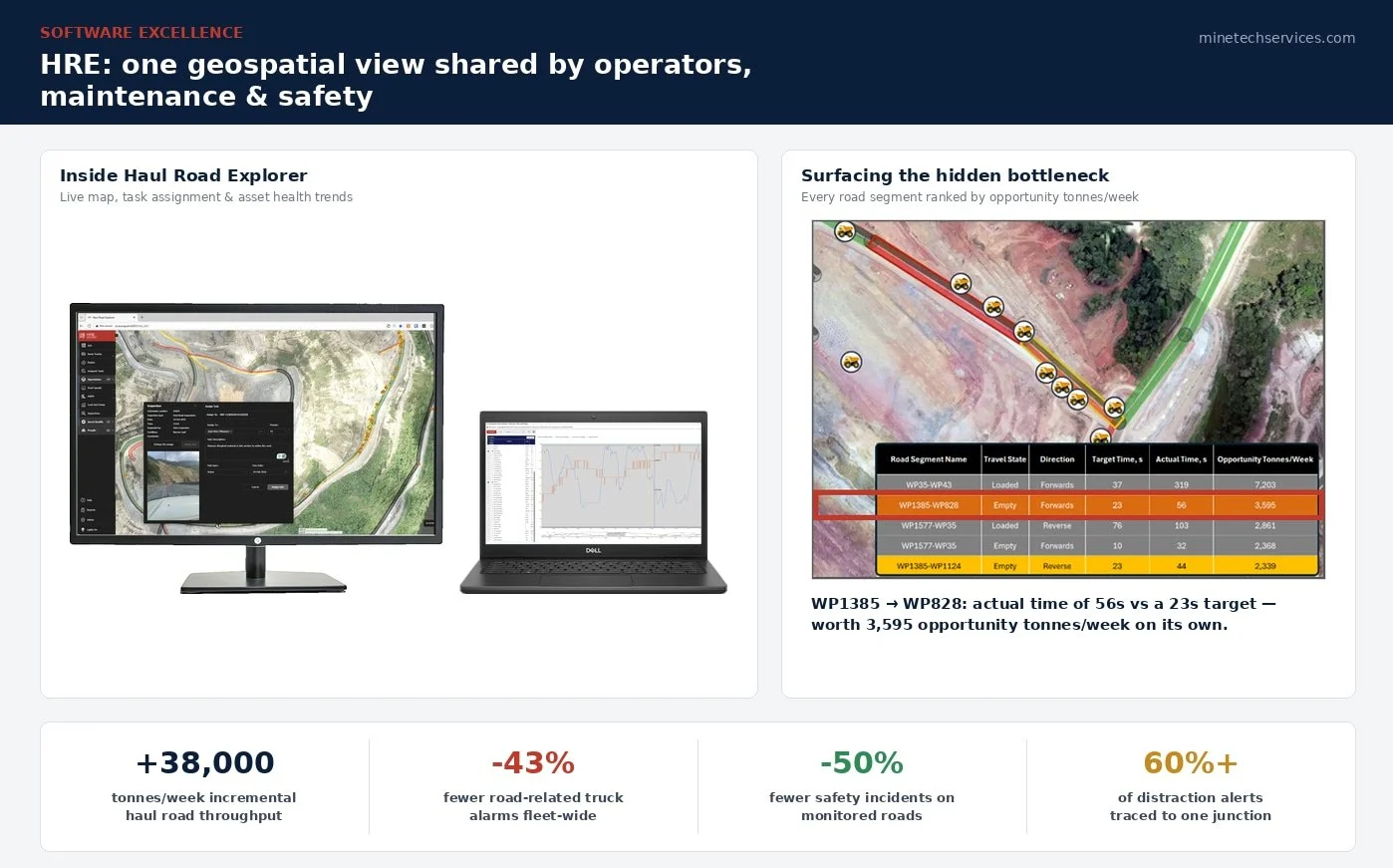
Haul Road Explorer (HRE) closes that gap. Using an intuitive map interface, it pulls data from existing systems into one geospatial view shared across operations, maintenance, asset health, and safety teams, automatically surfacing the haul road segments doing the most damage to production before losses compound.
The outcome
The intersection nobody noticed. At a mature gold mine, HRE flagged a single intersection as a top repair opportunity, a problem that had been quietly costing the site tonnes for over six months without anyone clocking it. The road surface looked fine in isolation, and no individual operator or machine seemed responsible. But HRE's map view also carried distraction and fatigue monitoring data, and it showed that more than 60% of all distracted-driving events at the site were concentrated at that one junction. A fresh inspection found the cause: a high berm blocking visibility and unclear right-of-way signage, causing operators to slow and creep through the junction on every cycle, triggering distraction alerts and losing speed each pass. Within days, signage was improved and the berm lowered. Six months of hidden underperformance, identified and resolved in a week.
The pinch point on the main haul ramp. At a large tropical open-pit operation, HRE flagged two adjacent sections of the main ramp out of the pit among the site's top five opportunities. Nothing looked obviously wrong until the data showed trucks repeatedly slowing, bunching, or stopping outright. An inspection confirmed it: the ramp had been built as a two-way road, but months of poor drainage and grading had quietly pushed material onto the verges, narrowing it into a one-way bottleneck. Empty trucks were stopping to yield to loaded ones, every pass, every shift invisible because no single data source told the whole story. Once the excess material was cleared and drainage improved, the fix kicked off a dedicated road-improvement programme at the site.
In its first quarter of deployment, this work delivered:
+38,000 tonnes of incremental throughput per week;
-43% reduction in road-related truck alarms;
-50% reduction in safety incidents.
What This Means for Your Operation
If any of this sounds familiar: automation assets that sit idle for reasons nobody can quite explain, haulage costs creeping up, or recurring incidents at a spot that "just always seems to cause problems," there's a good chance the fix doesn't need new capital. It needs the data you already have, properly connected.
That's what MTS does: independent, vendor-agnostic mining technology consultancy paired with purpose-built software like Haul Road Explorer, the Trend Exception Tool, and the Equipment Data Interface.
Get in touch with MTS to talk about your site's data, or explore Haul Road Explorerin more detail.
Frequently Asked Questions
-
MTS is shortlisted in two categories: Underground Excellence, for a shift-change optimisation project built with a global tier-one mining company, and Software Excellence, for its Haul Road Explorer platform.
-
Category winners will be announced in September 2026, alongside the September print edition of Mining Magazine. Now check the full shortlist announcement for details on all categories.
-
By blending data already generated across five separate OEM systems — Caterpillar MineStar, Epiroc/Meglab, Micromine Pitram, Newtrax, and VANTAGE — into one minute-by-minute timeline of machine and human activity, exposing exactly where time was being lost during shift change.
-
Haul Road Explorer is MTS's browser-based haul road analytics software. It unifies road, machine, operator, and safety data into a single geospatial view, helping operations, maintenance, and safety teams find and fix the highest-value repair opportunities before losses compound.
-
Yes, at one site, combining haul road performance data with distraction monitoring revealed that a single poorly designed intersection was responsible for the majority of distracted-driving alerts. Fixing the sightlines and signage cut both alarms and risk at that location.
