
Grade Control Improvement – Reduction of Overmining
Type: Productivity
Site: Surface Gold Mine
Location: South America
Outcome:↑ 75% reduction in overmining, 5% reduction in material mis-dumps.
The Task
A new gold mine in South America was experiencing challenges in meeting its material grade requirements due to excessive dilution. Despite investing in advanced high-precision machine guidance systems, the site was not achieving the expected grade control performance. This had become more urgent as the operation moved into higher-grade zones, where tighter control would directly affect recovery. MTS was engaged to review existing practices and identify opportunities to reduce overmining, improve block compliance, and ensure material was being correctly classified and sent to the right destination
The Solution
The operation had made a considerable investment in high-precision machine guidance systems to support grade control and improve excavation accuracy. However, these systems were not being used to their full potential. The technology had not been properly configured or integrated into daily operations, and as a result, operators lacked the tools and confidence to consistently follow block boundaries or maintain bench compliance.
Compounding the issue was the fact that the site was relatively new and had limited experience with both mining processes and the supporting technology. Without clear operational procedures or sufficient training, key practices around loading, compliance monitoring, and stockpile management were inconsistent or missing altogether.
As a result, the site was regularly failing to meet its material grade requirements. This led to significant dilution, with valuable ore being mixed with waste or misclassified entirely. To put the impact in perspective, just a 1% decrease in dilution can deliver up to $2 million in extra value annually when benchmarking an average mine site. These inefficiencies not only reduced the value of material sent to the plant but also increased operational costs — making it critical for the site to regain control over how material was mined, moved, and classified.
The Analysis
The first step was to undertake a structured review of the site’s operating practices and the way existing technology was being used. This assessment aimed to uncover the root causes of material dilution and to quantify, where possible, the extent of overmining and misrouting. It quickly became clear that while high-precision machine guidance systems had been installed, their configuration and day-to-day application were inconsistent, limiting their effectiveness.
Based on the findings, MTS introduced new processes to support more disciplined loading practices. These were backed by custom-built dashboards and reports that gave supervisors and control room staff real-time insight into block and bench compliance. The solution tracked specific issues, such as validating bucket load positions, benches being mined too deep, trucks misrouted to the wrong dump, and shovels cutting outside the boundary lines. It’s also worth noting that high precision data can be a solid alternative for day-to-day checks, reducing the need for surveys and providing daily updates to assist with month end reconciliation. Including these checks made the problem clearer for the team and highlighted where action was needed. Most importantly, the dashboard was built to fit seamlessly with the site’s existing workflow, so supervisors and operators could adopt it without changing how they already worked. By surfacing key performance indicators and exceptions as they occurred, these tools enabled faster interventions and tighter control over material movement.
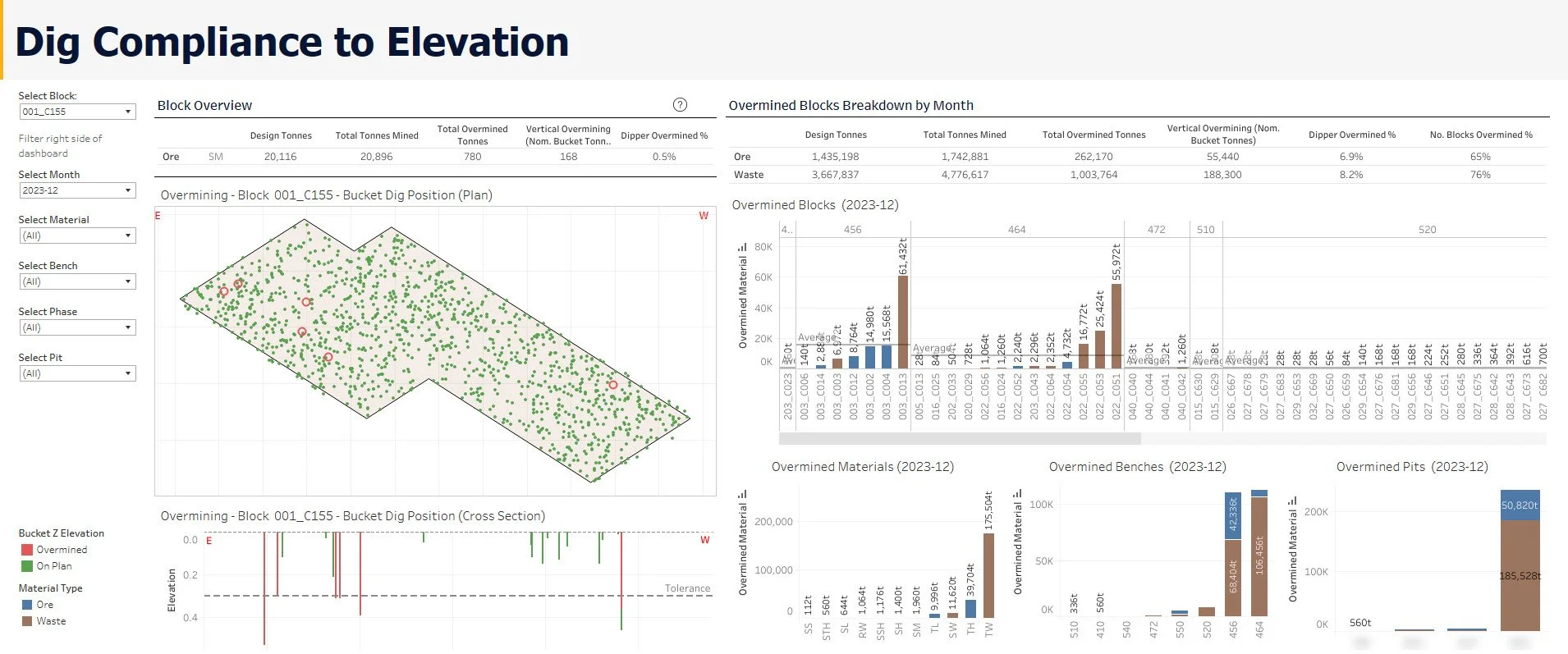
Alongside the technical and process improvements, operational teams were given direct support on the ground. Loading tool operators received in-cab mentoring to help them work confidently within block boundaries and make better use of onboard systems. Supervisory staff were also trained to interpret dashboard outputs and integrate compliance monitoring into daily routines.
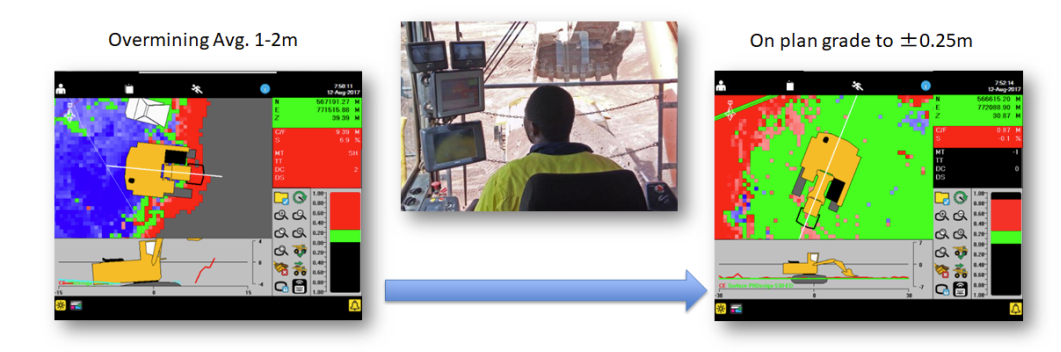
Together, these actions helped shift the site from reactive to proactive control over grade quality, with data and technology used not just for tracking performance, but for influencing it in real time.
The Results
One of the most impactful results was a 75% reduction in overmining, with bench compliance improving from a deviation of 1–2 metres to within ±0.25 metres. This was achieved through the proper calibration and configuration of the high-precision machine guidance systems, allowing operators to position buckets more accurately and mine strictly within the designed block limits.
In addition, a 5% reduction in material sent to the wrong destination was recorded. This equated to around 3,500 tonnes annually of high-grade ore not being dumped on the waste pile, while also avoiding hundreds of hours of rehandle. By reorganising and correctly configuring stockpiles within the FMS, the site gained tighter control over ore and waste movement, reducing misclassification and minimising blending errors at the plant.
Operators, having received focused training and in-cab mentoring, demonstrated improved confidence in using the technology to maintain block and bench accuracy, even in challenging field conditions. Real-time dashboards and reporting tools allowed supervisors to track compliance and address issues as they emerged, further reinforcing disciplined excavation practices.
Summary
Through its collaboration with MTS, the operation established a more data-driven and disciplined approach to managing grade control. Real-time visibility and structured processes enabled faster responses to compliance issues, while improved training gave operators and supervisors the tools to make confident, informed decisions in the field. The key takeaway being that success is driven not only by the technology purchased but by how it is configured and integrated into daily workflows. These improvements strengthened alignment between planning and execution, reduced material losses, and positioned the site for more consistent, high-quality mining performance going forward.
Frequently Asked Questions
-
Across an average mine site, a 1% reduction in dilution can be worth up to $2 million a year. At this operation, mis-routed material alone put roughly 3,500 tonnes of high-grade ore onto the waste pile every year. Ore dumped as waste is paid for twice — mined once, then rehandled or lost entirely.
-
Digging outside the lines, mostly. At this South American gold mine, benches were mined too deep, shovels cut past boundary lines, bucket positions went unchecked, and trucks were routed to the wrong dump. The mine was new, so procedures for loading, compliance monitoring and stockpile management were inconsistent or missing. Good equipment does not replace them.
-
By tracking bench and block compliance as it happens. MTS built dashboards showing dig compliance by elevation, flagging benches mined too deep, shovels cutting outside boundary lines and trucks sent to the wrong dump. High-precision data also supports daily checks, reducing the need for surveys and helping month-end reconciliation. Supervisors act the same shift, not weeks later.
-
It was installed, not configured. The site had invested in high-precision guidance systems, but they had never been set up correctly or built into daily work. Operators had no confidence following block boundaries. MTS recalibrated and configured the systems, then mentored operators in the cab. Same hardware, 75% less overmining.
