
Truck Frame Life Extension
Type: Asset Health
Site: Surface Mine
Location: USA
Outcome:↑ 41% reduction in road-related alarms, 44% decrease in total crack count, 2% increase in truck productivity
The Task
The mining industry is characterised by demanding operational conditions and high costs. Extending the lifespan of critical equipment, such as haul trucks, is paramount to maintaining profitability and sustainability. This case study examines a surface gold mine in the USA that successfully employed Haul Road Explorer (HRE) to help extend the life of its haul truck frames while simultaneously improving operational efficiency.
The Challenge
The mine was approaching the end of its operational life and faced the challenge of managing haul truck frames beyond their originally planned lifespan. Excessive cracking, poor road surfaces, and overloading were accelerating frame deterioration. Without intervention, the mine risked costly repairs, equipment failures, and compromised production targets.
The Solution
To address these challenges, the mine implemented a comprehensive program which included the use of HRE and other data-driven tools.
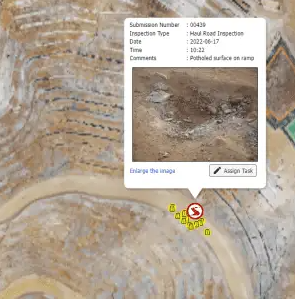
A potholed ramp surface photographed in the field and pinned to its exact location on the HRE map. The Assign Task button is what matters — it turns an observation into someone's job, with a date against it.
HRE was used to identify and rectify road-related alarms, such as rack, pitch, and bias events, preventing further damage to truck frames. Within HRE these can easily be plotted within the map view, enabling the user to identify event quantities alongside geospatial locations. Using this, the teams were able to quickly target and remedy problem areas.
Additionally, HRE’s inbuilt inspection tool proved invaluable. Mine personnel could capture and plot photographs of road conditions directly onto the HRE map, fostering real-time collaboration and awareness. Issues could be identified, communicated, and addressed promptly.
A robust system of accountability and measurement was established through the HRE task assignment tool. By assigning tasks to the events and inspections, the mine ensured that actions were completed, creating a traceable closed loop process from issue identification through to remediation. Using this they could also effectively analyse pre- and post-task conditions through an automatic data snapshots viewable in supporting dashboards. This data-driven approach supported continuous improvement.
Alongside this, dashboards were used to monitor loader technique and payload optimisation to prevent overloading and excessive road stress.
The Results
The comprehensive program yielded impressive results:
Extended Haul Truck Frame Life: The mine successfully managed haul truck frames to the end of the mine life, avoiding costly repairs and failures.
Reduced Road-Related Alarms: HRE contributed to a 41% reduction in road-related alarms.
Decreased Crack Count: The total crack count decreased by 44%.
Improved Productivity: Despite an overall average payload reduction, truck productivity increased by 2% due to optimised road and payload conditions.
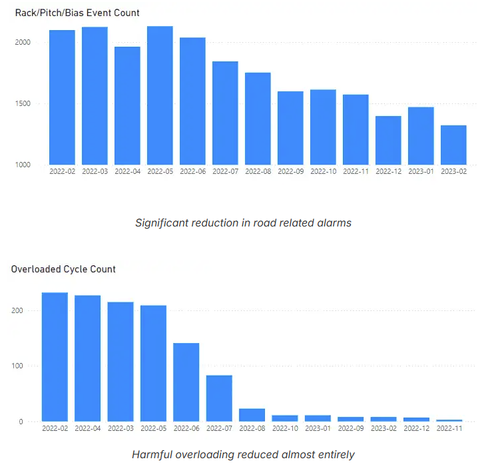
MTS Truck Frame Life Extension Results
Summary
This case study demonstrates the effectiveness of a comprehensive approach to haul truck frame management, with HRE as a cornerstone. By proactively addressing challenges, leveraging data-driven insights, and fostering accountability, the mine achieved significant improvements in equipment lifespan, operational efficiency, and cost savings.
The integration of HRE’s inspection and task assignment tools enhanced collaboration, accountability, and data-driven decision making. These findings provide valuable insights for other mining operations seeking to optimise their haul truck fleets and improve overall performance.
By adopting similar strategies and leveraging advanced technologies, mines can extend equipment life, reduce costs, and enhance production.
Frequently Asked Questions
-
Average payload fell, yet productivity still rose 2%. Smoother roads and better controlled loads mean trucks travel faster and spend less time in the workshop. An overloaded truck on a rough road is not a productive truck — it is a slow one with a cracking frame. Payload and productivity are not the same thing.
-
Bad roads and overloading, working together. Rack, pitch and bias events — the twisting and jolting a truck takes over uneven ground — send stress straight into the frame. Overloading adds more on every cycle. At this USA gold mine both were happening at once, and the frames were already being run past their planned life.
-
This mine was close to the end of its life, so buying new trucks was not an option. It ran the frames it already had to the finish instead. Alarms fell 41% and cracks fell 44%, avoiding repairs and failures that would have cost production. Late-life operations often have the most to gain, because replacement is off the table.
-
By closing the loop. Mine personnel used HRE's inspection tool to pin photographs of road damage onto the map, then the task assignment tool gave every issue an owner. Automatic before-and-after data snapshots showed whether the repair worked. An issue that gets logged but never assigned does not get fixed.
