
Effective use of Aux fleet – Motor Graders
Type: Productivity
Site: Surface Mine
Location: South America, Peru
Outcome:↑ 52% increase in grader utilisation, 32% reduction in unused time, and eliminated the need for costly auxiliary fleet purchases.
The Task
A mining operation with an extensive road network faced challenges in completing essential road maintenance tasks. Auxiliary fleet utilisation is an important metric to monitor, where efforts should be made to ensure it remains high, especially in challenging climates and geological conditions. At the operation, concerns arose about a potential shortage of road maintenance equipment and its utilisation. MTS collaborated with the site to implement strategies that improved fleet utilisation and road maintenance efficiency.
Challenge
The mine’s vast road network, situated in a demanding climate, required a high level of maintenance. However, proactive management and planning of road maintenance activities was limited. Roads were experiencing high rates of degradation with limited remedial work being conducted. The site initially assumed that this was due to the limited availability of auxiliary equipment. Existing reporting primarily focused on load and haul or drill and blast operations, neglecting road maintenance. The site therefore had limited insight into the exact reasoning behind these issues. Furthermore, limited use of delays and activity codes hindered understanding of the true utilisation of the fleet.
The Solution
The site engaged MTS to help better understand the root cause of the problem through the use of their data. To address these challenges, a comprehensive analysis was conducted. MTS aided the site with the following implementations:
Several dashboards were created to visualise grading timelines, including on/off and blading/non-blading periods. These dashboards allowed the site to monitor auxiliary fleet activity and track when they were/weren’t actively grading the road.
The site was running Haul Road Explorer (HRE) at the time of the investigation. HRE is a versatile tool that allows for developments and expansions if the data is available. MTS therefore deployed a new feature within HRE, which enabled the site to pinpoint grading locations and display the information geospatially across the site.
A Road fleet planner report was created using HRE workflows. The Top 5 opportunity roads were identified, along with planned development areas. This enabled the site to effectively utilise the auxiliary fleet, helping focus and plan work for graders.
The Results
The implementation of these strategies yielded significant results. The site saw a 52% increase in grader utilisation and a 32% decrease in unused time, where the engine was off. This was predominantly a result of:
Report uptake and incorporation into processes: The site adopted the road fleet planner report as part of its weekly/daily planning processes. HRE task assignments were used to drive grader workflow, leading to a substantial increase in grader utilisation.
Focus on priority roads: By focusing on the Top 5 opportunity roads and planned development areas, graders were deployed more effectively, minimising downtime and power-off periods.
Improved Road Maintenance Efficiency: The combined efforts of proactive planning, data-driven insights, and optimised fleet utilisation resulted in enhanced road maintenance efficiency.
No New Fleet Purchases: The successful implementation of these strategies eliminated the need for additional auxiliary fleet purchases, avoiding substantial and unnecessary costs.
A mine haul road before, during and after targeted grading
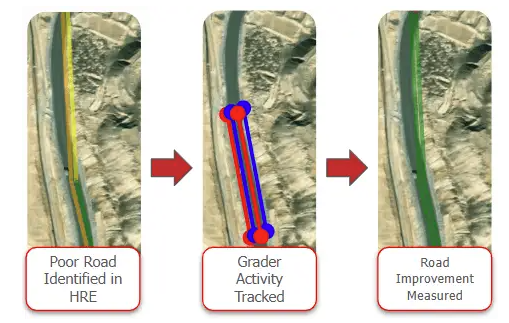
Before – During – After Effect of Road Improvements
Summary
This case study demonstrates the effectiveness of data-driven insights and optimised fleet management for improving road maintenance efficiency within a mining operation. By leveraging HRE data, creating informative dashboards, and focusing on high-priority areas, the site achieved substantial improvements in grader utilisation and overall road maintenance performance. This collaborative effort between MTS and the mining operation highlights the potential for significant gains in productivity and cost savings through effective fleet management.
Frequently Asked Questions
-
Because nobody reports on it. At this Peruvian mine, existing reporting covered load and haul and drill and blast, but not road maintenance. Delay and activity codes were barely used, so the real utilisation of the grader fleet was unknown. A fleet nobody measures looks fully committed, whether it is or not.
-
By ranking them. MTS built a road fleet planner report in HRE that identified the Top 5 opportunity roads alongside planned development areas, so graders went where the gain was largest. The site adopted the report into its daily and weekly planning, and used HRE task assignments to drive grader workflow — which turned the plan into assigned work.
-
Look for blading, not running hours. MTS built dashboards that split grading timelines into engine on and off periods, and blading versus non-blading time. A new HRE feature plotted where grading actually happened across the site. A grader with its engine running is not necessarily a grader improving a road.
-
No. The mine had assumed its road problems came from a shortage of machines. The data said otherwise — the graders it already owned were not being used well, because nobody was planning their work. Utilisation rose 52% without a single new purchase. More equipment would have added cost and fixed nothing.
