
Payload Optimisation: Improved Productivity
Type: Productivity
Site: Surface gold mine
Location: West Africa, Ghana
Outcome:↑ Estimated monthly production gain of 50,700 tonnes.
The Task
A mature mine in Africa had problems with reaching their expected productivity levels. Having already invested in several modern technologies, changes seemed necessary on an operational level. To determine what changes needed to be implemented, Mine Tech Services (MTS) was engaged. MTS used the existing technologies to implement operational improvements, particularly on a payload optimisation level. By analysing the mine’s operational data, MTS found that there were large inconsistencies in the trucks’ loading statistics. Numbers varied widely across different operators and machines, with underloading and overloading occurring frequently.
Both the underloading and overloading of trucks can result in undesirable outcomes for mining operations. Underloading causes a discrepancy between the tonnes that could theoretically be hauled and the tonnes that are actually hauled. This discrepancy is called ‘missed hauled tonnes’. Minimising ‘missed hauled tonnes’ can aid the optimisation of any mining operation. The overloading of trucks is also undesirable, where increased truck strain during the loading and hauling process can damage trucks. This not only heightens maintenance costs but also hampers production, as inactive trucks do not contribute to the mining operation. Furthermore, overloaded trucks may be gear-restricted or have problems driving uphill, causing even more lost productivity.
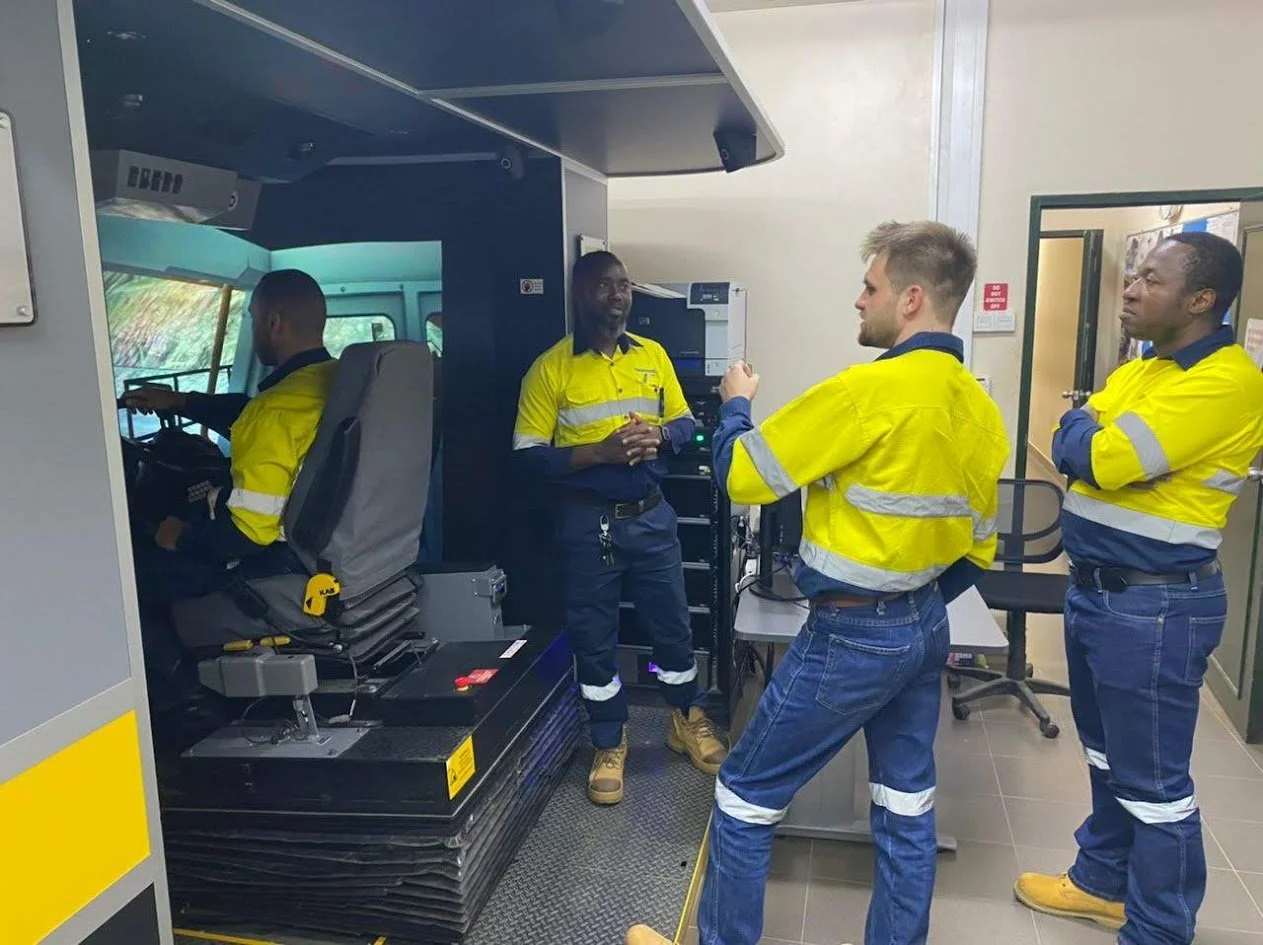
MTS experts Jean Marc and Jonny providing training on payload
Payload training on site. The scorecards made it possible to coach each operator on their own numbers rather than run one session for the room.
The Solution
In order to gain better oversight of how individual operators performed, scorecards containing data on their daily performance were introduced. This data could be used to provide specifically tailored training for each operator. This training was conducted using machine guidance systems, which were already in place at the mine. Also, immersive technology simulators were used to train operators, helping to address the common challenges they face on a daily basis. This combination of systems, together with the tailored training, enabled the mentoring of each operator on how to improve their productivity. Alongside this, payload distribution tools were introduced, to get a clearer overview of the spread in truck payloads across the fleet, crews and operators. This helped to refine the general loading practices at the mine, leading to renewed in-field guides and indicators, used to further aid the operators in their daily work.
The Results
The implemented measures had a significant positive impact on the mine’s operations. In the figures below, it’s evident how the payload histogram changed from a widespread distribution to something far tighter. Here, far more operators were hitting the payload targets alongside the occurrence of far fewer underloading and overloading events.
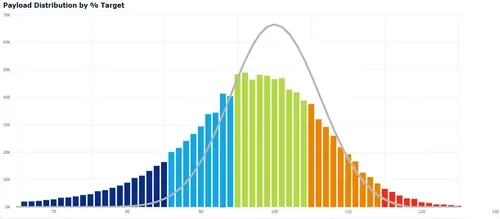
Before: payloads spread widely either side of target, with frequent under- and overloading.
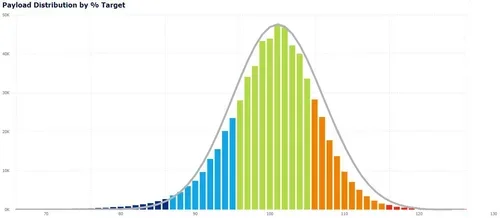
After: the same measure, far tighter around target. Fewer missed tonnes at one end, less truck damage at the other.
A large contributing factor in these improvements was behavioural changes among the operators. For instance, the incorrect assumption that overloading trucks results in increased productivity was eliminated. The data showed that overloading, by itself, can cause a two percent decrease in general productivity. Furthermore, the scorecards on operator performance were incorporated into the operator bonus incentive calculations. Ultimately, the measures taken resulted in a ten percent reduction in the severe underloading of trucks. The estimated monthly gain in production was 50,700 tonnes.
Summary
Despite having modern technologies in place, a mature mine had problems with its productivity. An MTS study found that payload optimisation could cause significant improvements. An important factor here was targeted operator training. By creating scorecards, training could be tailored to each operator’s needs. Besides this, the refining of loading practices and the use of immersive simulators were utilised. As a result, loading practices became much more efficient, resulting in significantly increased productivity.
Frequently Asked Questions
-
No. It reduces it. Data at this Ghanaian gold mine showed overloading on its own causes around a 2% drop in overall productivity. Overloaded trucks strain during loading and hauling, get gear-restricted, struggle uphill and spend more time under repair. A truck in the workshop hauls nothing. Correcting that belief was one of the biggest changes at the site.
-
The tonnes a truck could have carried but did not. When a truck is loaded below target, the gap between the theoretical load and the actual load is lost for that cycle and never recovered. Multiply it by every cycle, every truck and every shift, and the total becomes significant. Reducing it is one of the cheapest productivity gains available.
-
By looking at the spread, not the average. MTS introduced payload distribution tools showing how loads varied across the fleet, the crews and individual operators. Before the work the payload histogram was widely spread. Afterwards it was far tighter, with more operators on target and far fewer underloading and overloading events.
-
Measure each operator, then teach each operator. MTS introduced daily performance scorecards so training could be tailored to the individual rather than delivered to the room. Machine guidance systems already on site were used for coaching, alongside immersive simulators. The site then built the scorecards into operator bonus calculations, which is what made the change hold.
