
Gloablly, 2020 - 2026
Overview
Since its development, Haul Road Explorer (HRE) has been implemented by MTS at surface mining operations in South America, North America, Papua New Guinea and Africa. These deployments cover both conventional and autonomous haulage fleets, a range of commodities, and operating conditions from high-altitude and arid sites to high-rainfall tropical environments.
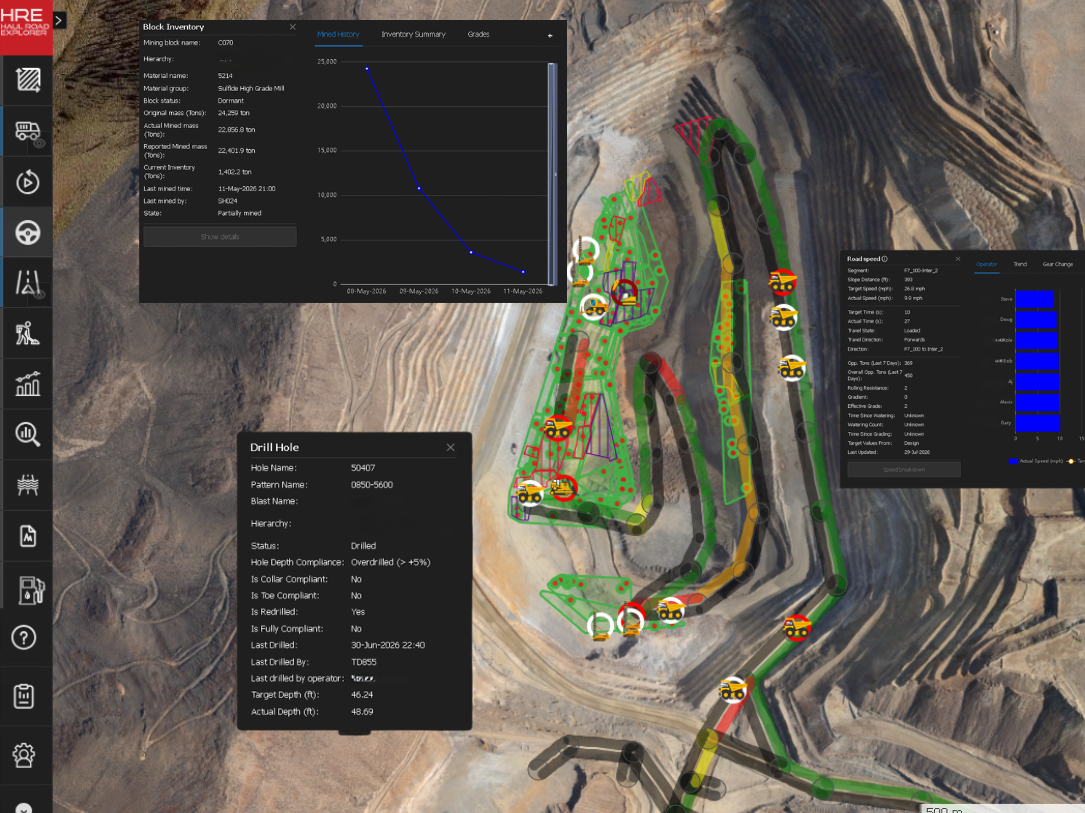
At each site, HRE replaced manual, inspection-based road management with a data-driven system that links road condition directly to truck performance and production. This allowed operations to quantify road-related lost tonnage, gain network-wide visibility of road condition, and plan maintenance proactively rather than reactively.
Implementation Model
Each deployment follows the same structured four-stage approach. This keeps implementation consistent across regions while allowing each site to be configured to its own needs.
Data integration and structuring: FMS, VIMS/MineStar and inspection data are consolidated, cleansed and validated into a single trusted dataset within HRE.
Platform configuration: The road network, RWPA analysis, event and inspection layers, and dashboards are set up around site priorities and departmental needs.
On-site departmental training: MTS engineers train Mine Engineering, Maintenance, Mine Services and Operations teams on-site, embedding HRE into daily and weekly planning routines.
Ongoing support: After go-live, MTS provides continuous support and introduces new features as site requirements evolve.
Regional Experience
South America: Implemented at large open-pit operations in high-altitude, arid conditions, where dust, long haul cycles and steep ramps put constant pressure on road quality. HRE gave engineering and maintenance teams a shared view of the road network that replaced fragmented, inspection-based reporting.
North America: Deployed at established mining operations with mature fleet management systems. HRE turned existing FMS and equipment data into road-condition insights, allowing teams to target maintenance where it had the greatest production impact.
Papua New Guinea: Applied in a high-rainfall tropical environment, where weather drives rapid road degradation. HRE helped the site move from reacting to damaged roads to planning maintenance ahead of deterioration.
Africa: Implemented across operations with different fleet sizes and road networks, demonstrating that the HRE model adapts to varied site maturity and infrastructure.
Results Across Deployments
Across implemented sites, HRE has enabled operations to:
Quantify production losses caused by poor road conditions
Identify and prioritise high-impact road segments for maintenance
Move from reactive repair to planned road maintenance
Give engineering, maintenance, services and operations teams a shared view of road performance
Conclusion
Developed from years of hands-on mining experience, HRE has proven adaptable across fleet types, commodities and climates. Its consistent implementation model allows MTS to deliver value quickly at new sites while building lasting in-house capability, turning haul roads from a hidden cost into a measured, managed asset.
Frequently Asked Questions
-
Haul Road Explorer (HRE) helps surface mines move from manual, reactive road management to a data-driven digital approach. Mines in four regions use it: South America, North America, Papua New Guinea and Africa. It gives sites better visibility of their haul roads, measures how much tonnage poor roads cost them, and supports proactive road maintenance planning.
-
Yes. Haul Road Explorer (HRE) is used in both conventional and autonomous haulage operations. It also runs across a range of mining conditions and commodities at surface mines in South America, North America, Papua New Guinea and Africa. The same implementation approach applies to each site, with dashboards and road networks set up to match local requirements.
-
No. Haul Road Explorer connects four groups: Mine Engineering, Maintenance, Mine Services and Operations. During implementation, MTS gives each department on-site training tailored to its role. HRE then becomes part of each team's daily and weekly routines. Because all four groups work from the same road data, their decisions on productivity, safety and cost line up.
